ESI’s Casting Simulation Suite: ProCAST

With our casting solutions you can Get it Right the first time and enhance your productivity & profitability

ESI’s Casting Simulation Suite, ProCAST, provides a complete set of solutions for
the foundry industry. An advanced tool which is the result of more than 25 years of collaboration with major industrial partners and academic institutions across the world, ProCAST offers an extensive suite of modules and foundry tools to meet today’s challenging industrial requirements. Based on the powerful Finite Element Technology, ProCAST enables
predictive evaluations of the entire casting process, including filling and solidification defects, mechanical properties and complex part distortion. It enables rapid visualization of effects of design changes and provides a basis for correct decision-making, from the earliest stages of the manufacturing process. ProCAST enables the modeling of all casting processes for all castable alloys, and also addresses other foundry relevant manufacturing process like core blowing & heat treatment.

QuikCAST solvers, fast and efficient solutions to address the basic of any casting process – filling, solidification,
porosity prediction – are available in the ProCAST environment. Optimization Solvers & Die Design Tools complete the ProCAST suite and are all offered under one single graphical user interface, Visual-Environment, aided by standard & intuitive workflows.

ESI’s Casting Simulation Suite has proven to be an indispensable tool for
foundries to validate decisions during prototyping, improve yield, and reduce manufacturing cost.

Visual-Environment: A Streamlined and Productive Interface

ESI’s Casting Simulation Suite ProCAST is fully integrated with ESI’s open collaborative engineering environment Visual-Environment allowing for interoperability and chaining between casting software and other simulation disciplines. Within Visual-Environment you can find Visual-Mesh Visual-CAST Visual-Viewer and Visual-Process.

Visual-Mesh comes with a CAD reader and specific tools to facilitate the link between CAD environment and meshing operations.

Visual-CAST provides foundry tailored wizards and data checks which guide users to set-up their casting process. An extensive material database is available with standard and commonly used alloys, dies, chills, sand molds & cores, ceramics, filters, insulation & exothermic sleeves. In addition, it also features a unique thermodynamic material database calculator which allows the user to directly enter the chemical composition of the alloy and automatically predict temperature-dependent properties required to accurately simulate the casting process.

Visual-Viewer is a complete, productive, and innovative postprocessing environment for foundry applications with a state-of-the-art plotting and animation control solution. It enables you to boost the productivity of your foundry engineers by performing automated tasks and generating customized reports within a multi-page/window environment.


From Quick Model Set Up

Originally created in 1985 by foundry professionals from Aluminum Pechiney, ESI’s QuikCAST is today
fully integrated into ESI’s ProCAST and available in the Visual-Environment. ESI’s QuikCAST meets
industrial needs delivering rapid and realistic predictions, allowing foundrymen the ability to simulate
the entire casting process from filling to solidification, including defects prediction.
Air back pressure, filters, mold roughness, thermal exchanges, die coatings and gravity are accounted
for to accurately simulate most casting processes ranging from sand to gravity, high and low pressure
die casting, for all kinds of castable alloys. Its validated technology is based on powerful solvers
with efficient self-correction features which result in comprehensive, realistic results without mesh
dependence. ESI’s QuikCAST has proven to be an indispensable tool in the foundry.
It is also used at an early stage for mold and process development for cast part quality assessment,
and has become a staple in foundries today.

Fast Process Evaluation

Model all of your shape casting processes with ESI’s QuikCAST using the Visual-Environment

Gravity Casting

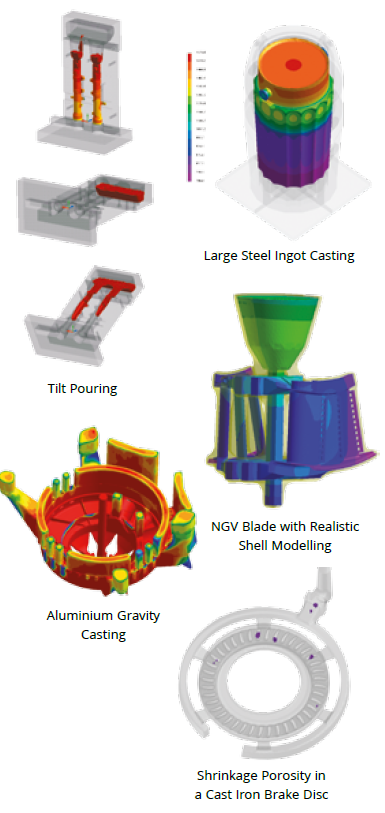
Most gravity casting processes, including sand mold, permanent mold, and tilt pouring, can be quickly modeled with ESI’s QuikCAST. Exothermic sleeves, chills, and filters (porous or extruded foam filters) are easily and automatically set up according to the process parameters. The embedded thermodynamic database in Visual-CAST offers graphite precipitation, thereby accurately predicting the shrinkage porosity, taking into account the expansion of cast irons. Misrun, Gate balancing, Thermal Modulus, and Hot Spots results can be visualized to validate the size and position of the risers.

Low Pressure Die Casting

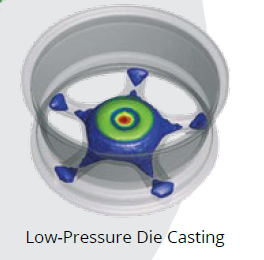
ESI’s QuikCAST has a complete set of dedicated tools to model the low pressure die casting process. During solidification simulation, the evolution of the solid fraction is calculated and used to predict shrinkage locations. Air back pressure calculations, together with appropriate user-defined pressure conditions, allow the simulation of vacuum casting processes.

High Pressure Die Casting

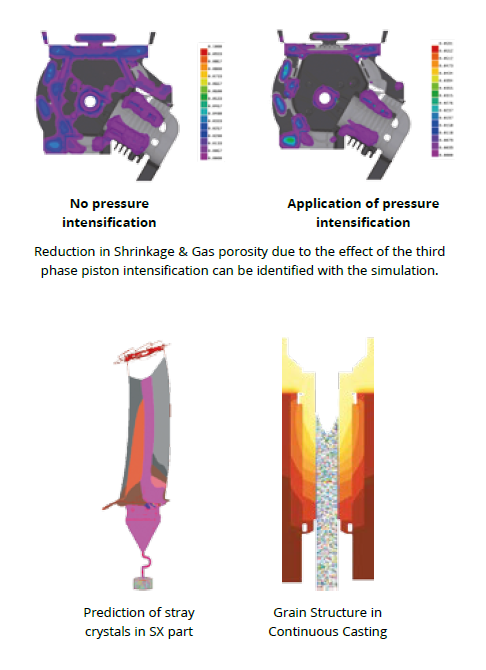
ESI’s QuikCAST allows you to perfectly simulate the piston displacement during the first phase injection as well as its influence on porosities during the third phase. Visual-CAST allows the definition of the mold cycling sequence, cooling, and heating devices through specific menus of the user interface, allowing faster pre-processing times. Advanced post-processing features like particle tracing are available to facilitate visualizing the metal flow.

ProCAST: Designed By Foundry Experts

Low & High-Pressure Die Casting

Allows for the reproduction of shop floor conditions by performing several production cycles to obtain steady state die temperatures and thereby study filling, solidification, intensification pressure effect, cooling channel design, and process parameters optimization. Vacuum process, gas porosity due to undissolved hydrogen, stresses in casting, stress release on die removal and part ejection, and die life can all be predicted in order to reduce manufacturing costs and assess in-service part performance. Specific needs including squeeze casting, semi-solid materials, shot sleeve modeling for cold chamber machines, goose neck modeling for hot chamber machines, and riser tube modeling in low pressure die castings can be achieved.


Gravity Die Casting and Tilt Pouring

Use ESI’s ProCAST to simulate gravity die casting including tilt pouring processes. You can freely define the axis and velocity of rotation.


Investment Casting & Shell Molding

ProCAST is able to automatically generate a mesh representing the shell mold suitable for Investment Castings and Shell Molding processes. Furthermore, it has dedicated features to address the specific needs of investment casting foundries, such as allowing for non-uniform shell thickness to be blended and multiple shell layers to be created. Also, radiation with view factors, including shadowing effects, which are critical for high temperature alloys, are taken into account.


Sand Casting

The key to success in a sand casting foundry is the optimization of the gating system and eliminating the risk of shrinkage porosity. ESI’s ProCAST allows comprehensive modeling of any sand casting process, including high pressure molding lines, and enables users to study the effects of feeder locations, filters, chills, insulation, and exothermic sleeves on the casting process and quality. Different aspects, including filling, solidification, and residual stresses, can also be studied.

The standard porosity model of ProCAST also accounts for the effect of the expansion of cast iron during solidification and mold rigidity, which allows or restricts this expansion. A more comprehensive approach involves running coupled thermal microstructure and porosity calculations, including inoculation. The microstructure solver computes the evolution of different phases and predicts local density variations, providing more realistic porosity results. Specific microstructure models exist for different cast irons, including GI, SGI, CGI, and Ni-Resist.

Solve Foundry Problems

Cold Shuts and Misruns

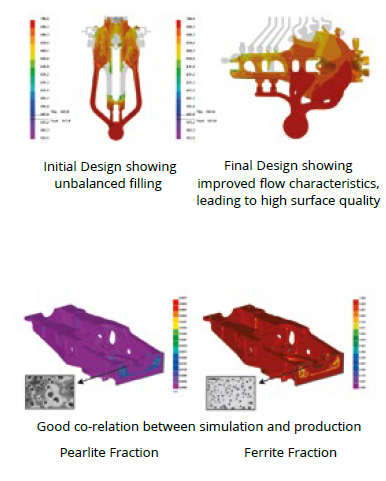
Some critical processing conditions, such as a cold mold, slow filling, and low casting temperature, can lead to problems during filling. The fully coupled thermal and flow computation enables the designer to assess the temperature drop of the melt during mold filling. Premature solidification adversely influences flow behavior. By capturing these phenomena, ESI’s ProCAST also predicts when and where incomplete filling or cold shuts may occur. The necessary design changes can be tested and validated at very low cost directly on the computer.


Piping, Shrinkage & Gas Porosity and Hot Spots

Piping & Shrinkage porosity are readily addressed by the standard solver. Hot Spots & Niyama are additional results provided by this standard solver. ProCAST provides a dedicated module to model gas porosity by accurately computing interdendritic shrinkage and accounting for gas content.


Air Entrapment, Air Entrainment, Inclusions, Oxides and Core Gases

Air bubbles or oxide layers trapped in areas where fluid flow is restricted may locally weaken the component in service. Turbulence during filling may lead to inclusions. These defects can be precisely analyzed in ProCAST, which helps designers optimize their gating system and better position the vents and flow offs.


Material Age, Flow Length, Colored Flow
and Thermal Modulus

Molten metal is tracked throughout the filling. ProCAST provides useful qualitative criteria like age, length, and colored flow to help design and balance the running system, such as in the case of multiple ingates. Thermal modulus is a useful output to redesign the feeding system.


Burn-On/Penetration

Very high temperatures in the mold could lead to burn-on or penetration defects.


Die Lifetime, Hot Tearing and Cracks

ProCAST allows a unique coupling between thermal, flow, and stress calculations. The full analysis is performed simultaneously on the same mesh. With ProCAST, you can investigate the thermal shock on the tooling during mold filling as well as the influence of gap formation between the casting and the mold during solidification. Hot tears, plastic deformations, residual stresses, and distortions are some of the issues that are tested by our customers.


Advanced Analysis

Microstructure and Heat Treatment

Microstructure formation is an important phenomenon affecting the end properties of an ‘as-cast’ component. ProCAST allows for the calculation of the types of phases present, the volume fraction of the phases, the grain size, and grain shape, all of which determine the mechanical properties.

The solid-state phase transformation and the resulting mechanical properties during heat treatment can also be simulated with ProCAST using models based on Time-Temperature-Transformation (TTT) or Continuous Cooling-Transformation (CCT) diagrams.

The microstructure solver also calculates the macro-segregation based on the composition of the alloy.

Originally developed by Rio Tinto Alcan, a heat treatment advisor calculates the mechanical properties (YTS, UTS, E% and HB) throughout the entire range—from T4 through T6 and T7—based on Mg variation and aging parameters for the most commonly poured aluminum A356/357.


Advanced Porosity Modeling

Developed in collaboration with Assan, Doncasters, Elkem, EPFL, Hydro Aluminium, Pechiney, Rolls-Royce, Sintef, Snecma, and VAW.

Most simulation solutions restrict porosity predictions to shrinkage porosity. ProCAST is the first commercial software that implements a physics-based approach for modeling both shrinkage and gas porosity. It includes a gas segregation model along with proper treatment of the solubility limit and pore nucleation.


Grain Structure Modeling

Developed in collaboration with ABB, AETC, EPFL, Howmet, PCC, Rolls-Royce, and Snecma.

Grain structure of ‘as-cast’ components is important for controlling casting conditions and optimizing component performance. ProCAST computes grain structure, including columnar to equiaxed transitions, for any dendritic alloy. It allows controlled solidification conditions to generate single crystal or directionally solidified grain structure. ProCAST couples a Cellular Automaton (CA) model with the Finite Element (FE) heat flow computations. For this reason, the grain structure module of ProCAST is often referred to as the CAFE module by industry experts.

What does Optimization Mean for Casting?

Automatically derive the best design and/or process conditions to reach optimal manufacturing conditions and product quality

ProCAST solvers are linked with ESI’s Optimization solvers to run an automated trial and error approach. The computer performs the best-chosen trials and makes decisions to improve process conditions and/or materials properties based on user-defined goals. Visual-Environment provides a set of guided workflows so users can set up these computer trials with ease. Several types of calculations can be used to drive manufacturing decisions, such as Design of Experiment, Optimization, Process Robustness, and Inverse Modeling.


Design of Experiment

Design of Experiment allows users to identify the sensitivity of the most influential process variables (e.g., increasing the shell temperature vs. adding insulation wrap). It also provides an opportunity to compare these influential variables to the economical aspects (e.g., energy costs for maintaining higher melt temperatures vs. production losses) and manufacturable aspects (e.g., creating a specific tool for feeding could be difficult) during production. This output can also be used to determine the optimization goals, in line with the known production constraints of a foundry.


Design Optimization

Automatically find the best design for:
• Riser locations & dimensions
• Chill locations
• Ingate positions
• Runner dimensions


Process Optimization

Automatically find the best process variables such as:
• Pouring temperature
• Pouring rate
• Die temperature

For user-defined objectives such as minimizing porosity, improving die-life, minimizing oxides, avoiding air entrapment in the shot chamber, etc.


Process Robustness

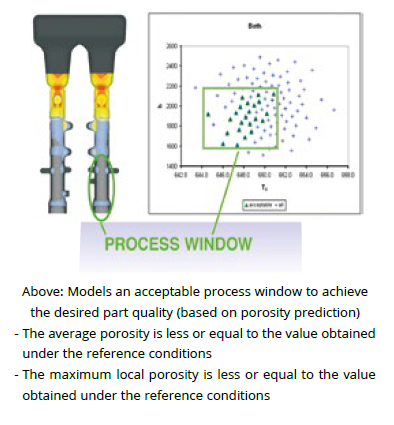
Allows foundrymen the possibility of evaluating the robustness of their process against the natural variation that occurs on the shop floor (e.g., metal pouring temperature). This application will automatically run a set of calculations accounting for this natural variation and provide the user with a process window, showing the maximum and minimum variations allowed in the process while still obtaining the desired results.


Inverse Module

The Inverse Modelling enables the automatic calculation of material properties or boundary conditions based on experimentally measured temperatures at given locations or times.

Additional Processes

Continuous Casting

ProCAST provides a complete solution for continuous and semi-continuous casting processes, including Direct Chill (DC) casting simulation. The software can simulate steady-state conditions as well as the initial and final stages of continuous casting processes. ProCAST also offers a unique capability: user functions that allow more advanced end users to program their specific process requirements. For example, user functions allow you to define boundary conditions as time, temperature, and space-dependent to accurately model any specific casting process.


Centrifugal Casting

Centrifugal and Coriolis forces are accounted for in ProCAST to model vertical centrifugal castings, including their effect on porosity prediction.


Lost Foam

ProCAST includes all the required features to account for the effects of liquid metal and foam interaction during a lost foam casting process.


Semi-Solid Modeling

ProCAST is equipped with different models to address the various physics of semi-solid modeling.


Core Blowing

Developed in collaboration with Ashland, CTI, CTIF, IMFT, Infun, Laempe, Teksid, and Weir Foundries.

The Core Blowing module predicts blowing and gassing defects, including incomplete fills, low compaction, and poorly hardened areas.

Selected Customer Testimonials

“The objective of DSB EURO s.r.o. is to satisfy the requirements of our customers regarding the quality of our products at the highest level. ProCAST helps us enhance the quality of our castings and ensure better competitiveness. Using ProCAST enables us to deliver castings on time and reduce unnecessary and repeated rework operations.”

Ing. Pavel Veselý, Production Director, DSB EURO s.r.o.


“Using ProCAST software, Sheffield Forgemasters International (SFIL) was able to analyze several virtual scenarios before delivering a “right first time” ingot casting. After forging it to produce the final roll shape and conducting NDT testing, it was evident that this was the highest integrity ingot ever produced at SFIL.”

Jesus Talamantes-Silva, R & D Manager, Vulcan SFM


“When you have the right tool in your hands, you can easily get quick and optimal solutions for extremely complex problems in superalloy foundry. ESI Software has the potential to do this.”

Ciro Caramiello, PhD – Process Modelling, EMA Rolls Royce


“If time and cost weren’t constraints, we could solve many issues without simulation. Thanks to ESI’s QuikCAST casting simulation software, we can test and improve our designs while building our internal expertise relative to various scenarios unseen before.”

Tu, Chin-Huang, General Manager, Zheng Yang Mould Manufactory


“ProCAST’s recent developments are excellent for predicting the microstructure and basic mechanical properties of casting materials. In addition, ProCAST addresses the complex phenomenon of graphite expansion in cast iron solidification. Using the microstructure module, simulation of local graphite expansion is possible with significantly higher accuracy for shrinkage defects prediction. This module opens new possibilities and enables analyses related to adjusting the metallurgical quality level using inoculation parameters in simulation.”

Dr. Antton Meléndez Arranz, Foundry Project Manager, Inasmet – Tecnalia

About ESI Group

ESI is a leading provider of Virtual Prototyping software and services with deep expertise in materials physics and Virtual Manufacturing. Established over 40 years ago, ESI specializes in helping manufacturers replace physical prototypes by creating virtual replicas of the fabrication, assembly, and testing processes in various environments. Virtual Prototyping allows clients to assess product performance and the impact of manufacturing conditions under different scenarios, ensuring products meet performance and certification goals before any physical prototypes are made. ESI’s solutions leverage advanced technologies in high-performance computing and immersive Virtual Reality to help companies visualize products before they are built. ESI serves a wide range of industries and employs around 1,000 specialists across more than 40 countries. For more information, visit www.esi-group.com.

Need more in-depth service?

If you have specific demand or need in-depth consultation, please submit your request to us.